
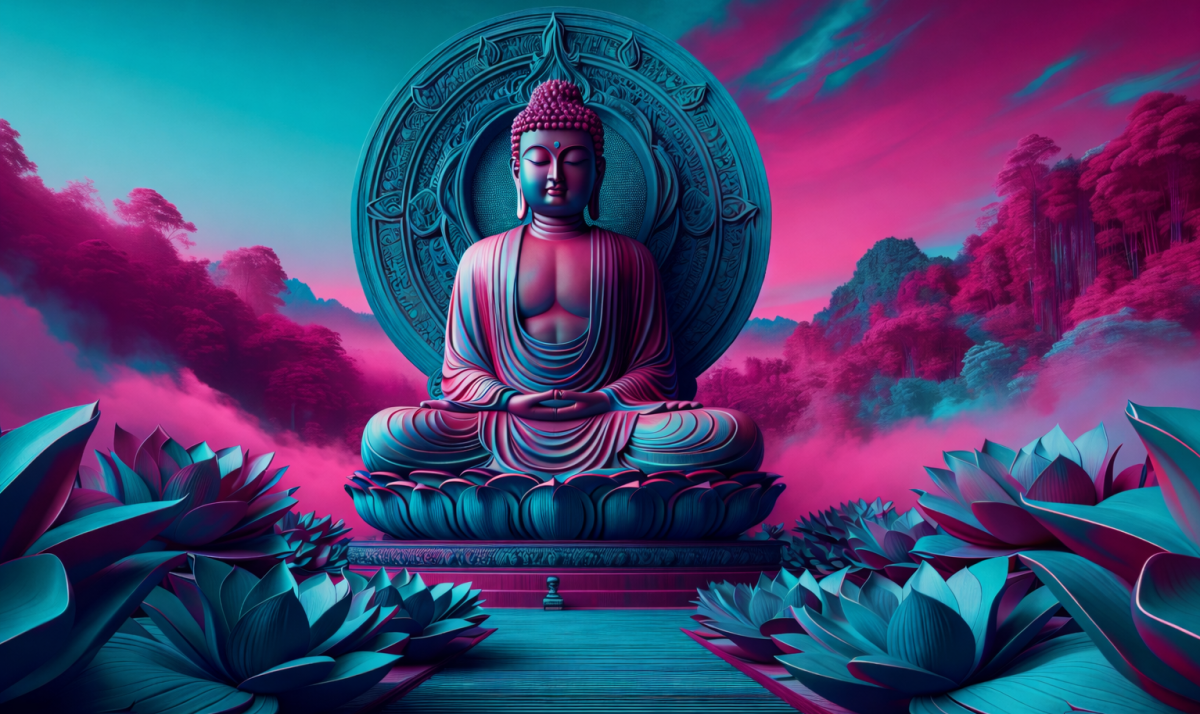

A Jewel Appears in the West
The Buddha was residing on Khalatika Mountain, surrounded by an immeasurable assembly of monks, great śrāvakas, and countless bodhisattvas.
Just as he concluded a discourse on the magnificent vows of the tathāgatas, a wondrous sign appeared in the western direction.
An Indranīla jewel shone forth, surrounded by hundreds of thousands of wish-fulfilling jewels. The radiance emanating from this jewel was unlike anything the assembly had ever witnessed. Its light spread throughout the entire trichiliocosm and eclipsed all ordinary forms.
Gods, humans, śrāvakas, bodhisattvas, and even the visible manifestations of the elements—earth, water, fire, and air—disappeared from sight. Only the luminous jewel remained visible.
Everything appeared vast, limitless, and beyond description, like infinite space itself.
Even the Buddha’s body shone with extraordinary clarity and brilliance.
A World Dissolved into Space
As the vision unfolded, the gathered beings found themselves unable to perceive even their own bodies.
They could no longer see one another. Their physical forms, shapes, and features vanished from perception. Even the sense of touch disappeared.
Whatever they attempted to observe appeared empty.
The sun and moon were no longer visible. The stars disappeared. The great elements could not be perceived. Sounds ceased to reach the ear, and fragrances no longer reached the nose.
Even the ordinary tendency to regard mind and mental events as “I” or “mine” faded away. The six cognitive faculties no longer generated their usual perceptions.
Yet something remained.
In every direction they looked, they beheld only the forms, colors, marks, and bodies of the tathāgatas.
Apart from the distant Indranīla jewel encircled by wish-fulfilling jewels, nothing else could be seen.
The Fearless Bodhisattvas
Among those present were bodhisattvas dwelling on the tenth ground, beings who had attained the meditative concentration known as Valiant Progress and who stood only one final lifetime away from buddhahood.
Though they witnessed this extraordinary dissolution of ordinary reality, they experienced no fear whatsoever.
They understood that all phenomena are inherently characterized by ultimate reality, suchness, and emptiness.
Because they had realized the true nature of things, they remained calm and unshaken.
The Confusion of the Assembly
The remaining members of the gathering were not so composed.
Bodhisattvas of lesser realization, śrāvakas, devas, nāgas, yakṣas, gandharvas, asuras, garuḍas, kinnaras, mahoragas, pretas, piśācas, and many other human and nonhuman beings were overwhelmed by fear and bewilderment.
Unable to distinguish what was before them or around them, they could not even perceive one another.
Filled with confusion, they repeatedly asked:
“What is this?”
“How has this happened?”
“What is the nature of this phenomenon?”
Yet no one could answer.
Bodhisattva Great Nail of Brahmā Speaks
At that moment, the bodhisattva Great Nail of Brahmā rose, folded his hands, and addressed the Buddha.
He explained that ordinary beings fail to recognize the true nature of phenomena. Mistaking appearances for reality, they become attached to the aggregates and are deceived by the six senses.
Although no fixed aggregate truly exists, beings cling to the idea of form and selfhood. As a result, some develop doubts regarding the Buddha’s teachings.
The Buddha therefore teaches the true characteristics of reality. Through his guidance, beings gradually come to understand the nature of phenomena and the vastness of space that accommodates all things.
Great Nail of Brahmā then praised the state revealed by the vision, describing it as a profound and inexpressible equipoise beyond ordinary concepts.
He spoke of the precious jewel resting upon the crown of the one responsible for this display, declaring that those fortunate enough to behold the distant Indranīla jewel would eventually perfect the meditative concentration of Valiant Progress.
He further proclaimed that all who had gathered before the Buddha were truly fortunate, for a profound teaching was about to be revealed.
Finally, he implored the Buddha to relieve the fear of the assembled beings and bring them to spiritual maturity.
The Buddha Reveals the Source of the Vision
The Buddha replied that the Great Nail of Brahmā had spoken correctly.
He explained that the experience before them belonged to the sphere of meditative concentration and was the activity of the bodhisattva Ākāśagarbha.
Ākāśagarbha, he said, had manifested a meditative concentration free from appearances and conceptual elaborations.
The extraordinary vision was not a random miracle but a demonstration of profound spiritual realization.
Beyond Eternalism and Nihilism
The Buddha then warned against attachment to two extreme views.
The first is eternalism—the belief that things possess permanent, unchanging existence.
The second is nihilism—the belief that nothing truly exists or matters.
Those who cling to either extreme become trapped in delusion.
Anyone wishing to attain liberation must transcend both views.
Rather than grasping at existence or nonexistence, practitioners should contemplate that which lies beyond conceptual expression. By doing so, they quickly advance through the bodhisattva grounds.
Teaching Emptiness Gradually
The Buddha then gave an important instruction regarding the training of beginning bodhisattvas.
Beginners should not immediately be introduced to the highest teachings in their most subtle form.
First, they should learn the six perfections through conventional explanations. They should understand phenomena in terms of arising and ceasing and become familiar with the workings of the elements and conditioned existence.
Only after developing this foundation should they be introduced to the deeper truth that all phenomena are ultimately inexpressible, unborn, unceasing, beyond perception, and devoid of inherent existence.
Approaching the Dharma in this gradual manner protects practitioners from falling into confusion.
By understanding both conventional truth and ultimate truth, they avoid the extremes of eternalism and nihilism.
Freed from attachment to phenomena, they quickly perfect the six perfections and advance steadily on the path to enlightenment.
The Return of Ordinary Appearances
When the Buddha finished speaking, the extraordinary vision came to an end.
The members of the assembly once again perceived the world as they had before.
Forms reappeared.
Sounds returned.
The great elements became visible once more.
Everything was seen, heard, understood, and known exactly as it had been before the vision arose.
Then the Buddha extended his right arm and began to describe the immeasurable qualities of the bodhisattva Ākāśagarbha.

