

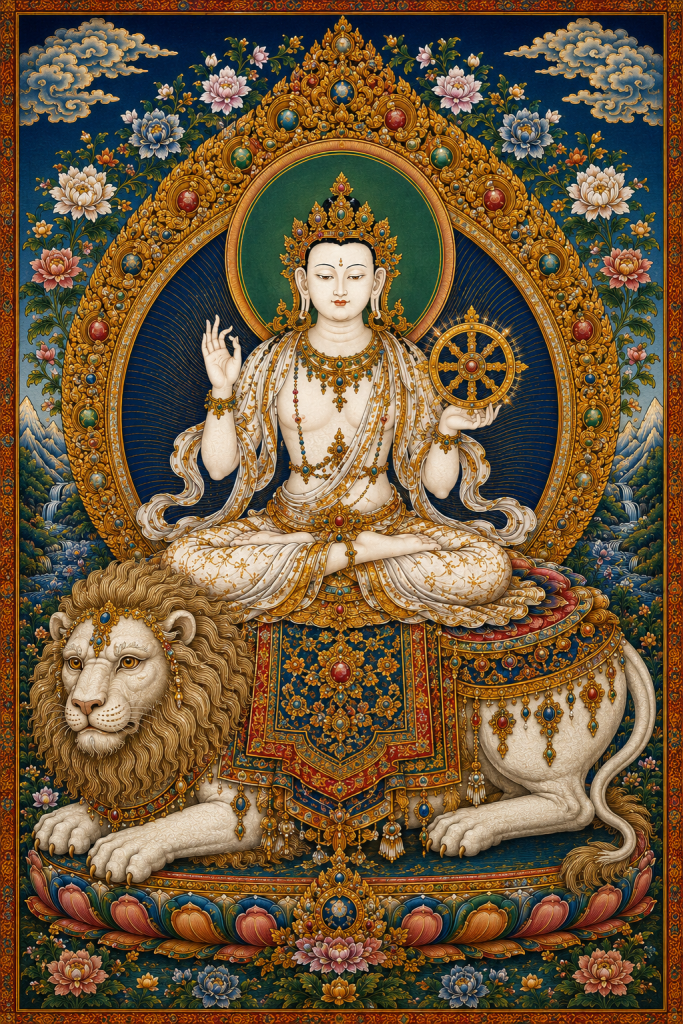
The Assembly of Vajradharas
The Setting of the Teaching
Thus have I heard.
At one time, the Blessed One Mahāvairocana was abiding in a vast adamantine palace within the Dharma Realm. This sacred realm had been empowered by countless tathāgatas and was filled with innumerable vajradharas who had gathered from every direction.
The palace itself was magnificent beyond description. It arose through the faith, understanding, spiritual play, and miraculous activities of the tathāgatas. Adorned with precious jewels of every kind, it stretched beyond all measure, having neither discernible center nor boundary.
Within this wondrous assembly stood a lion throne formed from the very body of a bodhisattva, symbolizing the inseparable union of wisdom and compassion.
The Great Vajradharas
Among those present were many exalted vajradharas, each embodying unique qualities and powers.
These included:
- Gaganāmala
- Gaganavikrama
- Gaganasaṃbhava
- Vicitrāmbaradhara
- Vicitracārin
- Sarvadharmasamatāvihārin
- Anantasattvadhātuparitrāṇa
- Nārāyaṇabalin
- Mahānārāyaṇabalin
- Suvajradhara
- Paramavega
- Vimala
- Vajrāgra
- Tathāgatavarman
- Tathāgatapadodbhava
- Aprapañcavihārin
- Tathāgatadaśabalasaṃbhava
- Vimalanetra
Foremost among them was Vajrapāṇi, the Lord of Mysteries.
Accompanied by countless vajradharas equal in number to the dust particles of ten Buddha-fields, they gathered around Mahāvairocana in reverence.
The Gathering of the Great Bodhisattvas
Surrounding the assembly were great bodhisattvas renowned throughout the Buddhist world.
Among them were:
- Samantabhadra
- Maitreya
- Mañjuśrī
- Sarvanīvaraṇaviṣkambhin
Together they formed a vast congregation dedicated to the liberation of all beings.
In their presence, Mahāvairocana expounded the profound Dharma concerning the equality of body, speech, and mind—the enlightened state that transcends all limitations of time, space, and ordinary perception.
The Revelation of the Three Mysteries
Through the empowering radiance of Mahāvairocana, extraordinary manifestations appeared throughout the assembly.
The inexhaustible adornments of enlightened body became visible.
Likewise, the inexhaustible adornments of enlightened speech and enlightened mind also appeared.
These manifestations did not arise from ordinary causes, nor could their beginning or end be discerned.
They were expressions of the awakened activity of Mahāvairocana, continuously benefiting beings throughout the universe.
Every action of his body proclaimed the Dharma.
Every expression of his speech revealed the Dharma.
Every movement of his mind communicated the Dharma.
In countless worlds and among innumerable beings, the teachings of the mantra path were continuously being made known.
Manifesting in Countless Forms
For the benefit of sentient beings, Mahāvairocana appeared in many forms.
At times he manifested as vajradharas.
At other times he appeared as bodhisattvas such as Samantabhadra and Padmapāṇi.
Through these various forms he taught beings according to their capacities, dispositions, and spiritual needs.
His purpose was always the same: to guide beings from their first awakening of the bodhi-mind all the way to complete enlightenment.
Through these teachings, the seeds of ignorance and karmic conditioning could be removed, while the seeds of wisdom and awakening could begin to grow.
The Beginning of the Dialogue
As the assembly listened, Vajrapāṇi, the Lord of Mysteries, rose and addressed Mahāvairocana.
Recognizing the profound significance of the Buddha’s realization, he wished to understand its deepest source.
With great respect, he prepared to ask a question that would form the foundation of the entire discourse:
How does a Buddha attain the knowledge of omniscience, and what is the true cause, root, and culmination of enlightenment?
Vajrapāṇi’s Question and the Knowledge of Omniscience
The Question of Enlightenment
As the great assembly listened to the teachings of Mahāvairocana, Vajrapāṇi, the Lord of Mysteries, rose from his seat and addressed the Buddha with deep reverence.
He wished to understand the very heart of enlightenment itself.
Although the Buddha taught countless beings according to their needs and capacities, Vajrapāṇi perceived that all these teachings must arise from a single source. He therefore asked the Buddha:
“How did the Tathāgata attain the knowledge of omniscience? What is its cause? What is its root? And what is its final culmination?”
This was not merely a question about the Buddha’s personal awakening. It was a question about the very foundation of the path itself.
The Universal Activity of the Buddha
Vajrapāṇi reflected upon the Buddha’s extraordinary activity in the world.
For some beings, the Buddha taught the path of the śrāvakas.
For others, he taught the path of the pratyekabuddhas.
For others still, he revealed the Great Vehicle.
He guided gods, humans, nāgas, yakṣas, gandharvas, and countless other beings according to their capacities.
When necessary, he appeared as a Buddha.
At other times, he appeared as a bodhisattva.
He could manifest as a śrāvaka, a deity, a heavenly king, or any other form required to guide living beings toward liberation.
Though these manifestations appeared diverse, Vajrapāṇi understood that they must arise from a single realization.
He therefore sought to understand the source from which all these teachings flowed.
The Knowledge of an Omniscient One
Vajrapāṇi described the knowledge of a Buddha as something vast and universal.
Just as space accommodates all things without preference or limitation, the knowledge of omniscience remains free from all divisions and distinctions.
Just as the earth supports all beings without discrimination, the Buddha’s wisdom supports gods, humans, and all forms of life.
Just as fire consumes fuel without becoming exhausted, the knowledge of omniscience burns away ignorance wherever it is found.
Just as wind scatters dust and clears the air, enlightened wisdom removes the obscurations created by mental afflictions.
And just as water refreshes and sustains all living beings, the knowledge of a Buddha brings benefit, happiness, and liberation to all who encounter it.
Yet despite these analogies, the true source of this wisdom remained the central mystery.
What gives rise to such boundless knowledge?
What sustains it?
And what is its ultimate purpose?
The Buddha’s Praise
Mahāvairocana responded with words of approval.
“Excellent, excellent, Vajrapāṇi!”
The Buddha praised him for asking a question of profound significance.
Questions concerning wealth, power, supernatural abilities, or heavenly rewards may benefit only a few.
But a question concerning the source of enlightenment benefits all beings.
The Buddha therefore invited Vajrapāṇi to listen carefully and contemplate deeply the answer that would follow.
The Cause, Root, and Culmination of Enlightenment
Mahāvairocana then revealed a teaching that stands at the heart of the entire sutra.
He declared:
“The bodhi-mind is its cause. Compassion is its root. Skillful means is its culmination.”
These three statements summarize the entire path to awakening.
The aspiration for enlightenment is the cause.
Compassion for all beings is the root that nourishes that aspiration.
Skillful means—the ability to help beings according to their needs—is the culmination and fulfillment of enlightenment.
The Buddha’s wisdom does not arise from intellectual brilliance alone.
Nor does it arise from ascetic practices, rituals, or philosophical speculation.
It begins with the awakening of bodhicitta, grows through compassion, and reaches completion through the active benefit of others.
What Is Bodhi?
Having explained the cause, root, and culmination of enlightenment, Mahāvairocana turned to the nature of bodhi itself.
He declared:
“Bodhi means knowing one’s own mind as it truly is.”
This simple statement contains profound implications.
Enlightenment is not something acquired from outside.
It is not something created.
Nor is it a distant object that must be obtained.
Rather, awakening occurs through directly understanding the true nature of one’s own mind.
To know the mind as it truly is is to know awakening itself.
Beyond All Concepts
The Buddha further explained that enlightenment cannot be grasped as an object.
Its nature resembles empty space.
It cannot be possessed, measured, or defined.
It transcends all concepts and distinctions.
Because it is beyond all characteristics, it cannot be captured through ordinary thought.
Just as space remains untouched by the objects that appear within it, the true nature of mind remains unstained by the countless thoughts, emotions, and experiences that arise and pass away.
For this reason, all phenomena ultimately share the same nature as space itself.
They are empty of fixed identity and beyond all conceptual boundaries.
The Foundation of the Teaching
Thus, at the very beginning of the Mahāvairocana Sutra, the Buddha establishes the foundation for everything that follows.
The path begins with the awakening of bodhicitta.
It is sustained by compassion.
It is fulfilled through skillful means.
And its realization depends upon directly knowing the true nature of one’s own mind.
Having heard these teachings, Vajrapāṇi prepared to inquire even more deeply into the mystery of mind, awakening, and the path to omniscience.
Knowing One’s Own Mind
The Search for Enlightenment
After hearing that the bodhi-mind is the cause of enlightenment, compassion its root, and skillful means its culmination, Vajrapāṇi wished to understand the teaching more deeply.
If enlightenment consists in knowing one’s own mind, then who is it that seeks enlightenment?
Who attains awakening?
Who generates the knowledge of an omniscient one?
These questions strike at the heart of spiritual inquiry. They challenge the ordinary assumption that there is a fixed self progressing toward a distant goal.
Vajrapāṇi therefore asked the Buddha to explain this mystery.
Enlightenment Is Found Within
Mahāvairocana replied that bodhi and omniscience are not found outside oneself.
Rather, they are discovered within one’s own mind.
The reason for this is that the mind is originally pure.
From the very beginning, its true nature has never been stained or corrupted.
Although beings experience confusion, attachment, and suffering, these are not the mind’s essential nature.
They are temporary obscurations.
The mind itself remains fundamentally pure and luminous.
For this reason, those who seek enlightenment must look directly into their own minds rather than searching elsewhere.
The Mind Cannot Be Located
The Buddha then explained the mysterious nature of mind.
The mind cannot be found inside the body.
Nor can it be found outside the body.
Neither can it be discovered somewhere between the two.
Whenever one attempts to locate it, it remains beyond grasp.
It has no fixed position and no physical form.
Unlike material objects, it cannot be pointed to or possessed.
Its true nature transcends all ordinary categories of existence.
Beyond Color, Shape, and Form
Mahāvairocana further taught that the awakened mind cannot be described through any visible characteristic.
It is not blue.
It is not yellow.
It is not red.
It is not white.
It is not long or short.
It is not round or square.
It is neither bright nor dark.
It is neither male nor female.
Nor is it neuter.
All such distinctions belong to the realm of conceptual thought.
The true nature of mind transcends every attempt to define it through form, appearance, or identity.
Beyond the Realms of Existence
The Buddha explained that the mind is not confined to any realm of existence.
It does not belong exclusively to the desire realm.
Nor does it belong to the form realm.
Neither does it belong to the formless realm.
It cannot be identified with gods, humans, nāgas, yakṣas, gandharvas, or any other category of being.
Although all beings experience mind, the mind itself cannot be reduced to any particular mode of existence.
It remains free from every limitation imposed by names and classifications.
Beyond the Sense Faculties
The awakened mind is also beyond the six sense faculties.
It does not dwell within the eyes.
Nor within the ears, nose, tongue, body, or ordinary consciousness.
It cannot be seen.
It cannot be heard.
It cannot be touched.
It cannot be grasped through any sensory experience.
This does not mean that the mind does not exist.
Rather, it means that its true nature transcends the ordinary means through which beings perceive the world.
The Nature of Space
To help explain this teaching, Mahāvairocana compared the mind to space.
Space accommodates everything, yet it remains untouched by whatever appears within it.
Clouds may arise and disappear.
Storms may come and go.
Yet space itself remains unchanged.
In the same way, thoughts, emotions, memories, and perceptions arise within the mind.
But the true nature of mind remains unstained by them.
Because it resembles space, the mind is free from all distinctions and limitations.
Mind, Space, and Awakening
The Buddha then revealed one of the most profound teachings of the chapter.
The nature of mind, the nature of space, and the nature of enlightenment are not separate.
They are free from duality.
What is identical to space is identical to mind.
What is identical to mind is identical to bodhi.
This does not mean that mind becomes enlightenment at some future point.
Rather, it means that the deepest nature of mind is already inseparable from awakening.
Realization consists not in creating enlightenment but in recognizing what has always been present.
Compassion and Skillful Means
Although enlightenment transcends all concepts, it is never isolated from compassion.
The Buddha again emphasized that compassion is its root and skillful means its fulfillment.
Understanding the nature of mind is not a purely intellectual exercise.
Its purpose is to liberate beings from suffering.
For this reason, wisdom and compassion must always develop together.
The deeper one’s understanding becomes, the greater one’s capacity to benefit others.
The Gateway to Awakening
Mahāvairocana explained that those who understand the true nature of mind enter the gateway to the bodhisattva path.
This realization marks the beginning of genuine awakening.
As practitioners deepen this understanding, obscurations gradually dissolve.
Their confidence grows.
Their wisdom increases.
Their compassion expands.
Step by step, they approach the realization attained by the buddhas.
Thus, the Buddha taught that the path to enlightenment begins not with seeking something new, but with recognizing the true nature of the mind that has always been present.
The Stages of the Ordinary Mind
The Many Forms of Delusion
Having explained the true nature of mind, Mahāvairocana next turned to the condition of ordinary beings.
Although the mind is originally pure, most beings fail to recognize its true nature. Instead, they become attached to false notions of self and cling to countless mistaken views.
Since beginningless time, beings have imagined the existence of a permanent self and have built their understanding of the world around this assumption.
As a result, they remain trapped within cycles of attachment, confusion, and suffering.
The Search for False Foundations
The Buddha explained that many people seek ultimate truth in things that cannot provide genuine liberation.
Some believe that time is the ultimate cause of existence.
Others believe that the material elements are the source of reality.
Some place their faith in a creator deity.
Others rely upon philosophical systems, intellectual speculation, or various concepts of a permanent soul.
Still others believe in a separate inner self, a life-force, consciousness, or some eternal essence hidden within existence.
Although these views differ from one another, they share a common mistake.
Each attempts to establish permanence where none can ultimately be found.
For this reason, they fail to reveal the true nature of reality.
Like Sheep Following a Path
Mahāvairocana compared ordinary beings to sheep moving together without understanding where they are going.
Occasionally they perform wholesome actions.
They may observe moral disciplines.
They may give gifts to others.
They may engage in religious practices.
These actions create merit and wholesome tendencies.
Yet because they remain bound by ignorance and mistaken views, they do not lead directly to awakening.
Their efforts produce beneficial results, but they do not reveal the ultimate truth.
The Growth of Virtuous Conduct
The Buddha then described how ordinary virtue develops in gradual stages.
A person may first cultivate simple moral restraint.
From this foundation, generosity begins to arise.
At first, one gives to family members and those closest to oneself.
Later, generosity expands toward friends, acquaintances, and strangers.
Eventually, offerings are made to virtuous individuals and spiritual practitioners.
As generosity deepens, the mind becomes increasingly refined.
Wholesome qualities begin to grow just as a seed gradually develops into a plant.
Although these practices do not yet constitute enlightenment, they prepare the ground for deeper realization.
The Desire for Heavenly Rewards
Many people engage in virtuous actions because they desire favorable future circumstances.
They observe ethical conduct.
They make offerings.
They perform religious acts.
Yet their motivation often remains focused on obtaining happiness, prosperity, or rebirth in heavenly realms.
The Buddha explained that such aspirations are still connected to worldly existence.
Though they may lead to fortunate rebirths, they do not free one from the cycle of birth and death.
Thus, even wholesome actions can become limitations if they are pursued solely for personal reward.
Reliance on Gods and Supernatural Powers
The Buddha observed that many beings place their hopes in powerful gods, celestial beings, and supernatural forces.
They believe that divine beings can fulfill their desires and remove their difficulties.
Out of faith and devotion, they offer worship and perform various rituals.
While such practices may produce temporary benefits, they do not address the root causes of suffering.
Dependence upon external powers cannot substitute for genuine wisdom.
True liberation arises through understanding the nature of mind and reality.
The Mind of the Child
Mahāvairocana referred to these early stages of spiritual development as the “mind of the child.”
This does not imply foolishness or condemnation.
Rather, it indicates a stage of growth.
Just as a child has not yet reached maturity, beings at this stage have not yet developed the wisdom necessary to understand the deeper truths of the Dharma.
Their actions may be sincere.
Their intentions may be wholesome.
Yet their understanding remains incomplete.
Nevertheless, these early stages serve as important foundations for future development.
The First Glimpse of Liberation
As individuals mature spiritually, a desire for liberation begins to emerge.
They start questioning the assumptions they once accepted without examination.
They become interested in deeper teachings concerning impermanence, emptiness, and the nature of existence.
Yet even here, misunderstandings can arise.
Some fall into the belief that everything is eternal.
Others conclude that everything is annihilated at death.
Some misunderstand emptiness and mistake it for complete nothingness.
Because they fail to understand the middle way, they remain trapped in conceptual extremes.
Beyond Eternalism and Nihilism
The Buddha emphasized that true emptiness transcends both permanence and annihilation.
It does not affirm an eternal, unchanging essence.
Nor does it deny the functioning of causes, conditions, and experience.
Those who cling to either extreme fail to understand reality as it truly is.
For this reason, genuine wisdom requires moving beyond all fixed views.
One must learn to see phenomena as they are: dependent, impermanent, and empty of inherent existence.
Preparing for Higher Realization
The Buddha’s purpose in describing these stages was not to criticize ordinary beings.
Rather, he wished to show how spiritual development unfolds.
Every practitioner begins somewhere.
Generosity, morality, faith, and religious devotion all serve important roles along the path.
Yet they represent only the beginning.
As understanding deepens, one gradually moves beyond external supports and conceptual beliefs.
Only then does one become prepared to investigate the deeper nature of mind and enter the path leading toward complete awakening.
The One Hundred and Sixty States of Mind
Vajrapāṇi’s Request
After hearing the Buddha’s explanation of the ordinary stages of spiritual development, Vajrapāṇi wished to understand the workings of the mind in greater detail.
He requested that Mahāvairocana explain the various states through which the mind passes as it wanders through confusion, develops understanding, and gradually approaches awakening.
In response, the Buddha began a remarkable analysis of the many tendencies and patterns that shape human experience.
The Diversity of Mental States
Mahāvairocana explained that the mind manifests in countless forms.
Sometimes it is governed by desire.
At other times it is free from desire.
Sometimes it is ruled by anger.
At other times it is filled with kindness.
It may be clouded by ignorance or illuminated by wisdom.
It may be plagued by doubt or strengthened by certainty.
The mind is constantly changing, taking on different forms according to conditions, habits, and circumstances.
Understanding these patterns is essential for anyone seeking liberation.
The Mind Shaped by Desire and Aversion
Many mental states arise through attachment and aversion.
The mind of covetousness constantly seeks what it desires.
It is never satisfied and continually pursues new objects of attachment.
The mind of anger reacts with hostility whenever its wishes are frustrated.
By contrast, the mind of kindness seeks the welfare of others and acts with gentleness and compassion.
These opposing tendencies reveal how differently the mind can respond to the same circumstances.
One leads to suffering and conflict.
The other leads toward peace and harmony.
The Mind of Ignorance and the Mind of Wisdom
The Buddha distinguished between the mind of ignorance and the mind of wisdom.
The ignorant mind fails to investigate reality.
It accepts appearances without examination and remains trapped in confusion.
The wise mind, however, carefully investigates experience.
It seeks understanding and continually deepens its insight into the nature of things.
Wisdom arises not from blind belief but from direct examination and understanding.
For this reason, the cultivation of wisdom becomes one of the central tasks of the spiritual path.
The Mind of Doubt and the Mind of Clarity
Some minds remain trapped in uncertainty.
They hesitate endlessly and cannot commit themselves to understanding or practice.
Such doubt prevents spiritual progress.
By contrast, the clear mind sees things without confusion.
It understands what should be accepted and what should be abandoned.
Clarity does not mean possessing all knowledge.
Rather, it means seeing reality without the distortions created by confusion and hesitation.
The Mind of Conflict
Mahāvairocana observed that many beings are naturally drawn toward argument and conflict.
Some constantly seek faults in others.
Others become attached to opinions and engage in endless debates.
They divide reality into opposing sides and become trapped in disputes.
The mind without conflict abandons attachment to winning arguments.
It is not concerned with proving itself right.
Instead, it seeks understanding and harmony.
Such a mind moves closer to wisdom because it is less bound by pride and self-interest.
The Symbolic Minds
To illustrate the many tendencies of human beings, the Buddha described a series of symbolic minds.
There is the mind of a god, which assumes that its wishes should always be fulfilled.
There is the mind of an asura, which delights in struggle and competition.
There is the mind of a nāga, which longs for wealth and power.
There is the mind of a merchant, always calculating gain and loss.
There is the mind of a farmer, patiently cultivating causes in the hope of future results.
Each image reveals a different tendency that can influence spiritual development.
Animal Symbols of the Mind
The Buddha also used animals as symbols for various mental habits.
The mind of a cat moves cautiously and slowly.
The mind of a dog becomes content with small gains.
The mind of a lion possesses fearlessness and confidence.
The mind of an owl remains attached to darkness.
The mind of a crow is constantly suspicious and fearful.
The mind of a garuḍa depends heavily upon external support.
These symbolic descriptions encourage practitioners to examine their own tendencies honestly and without self-deception.
The Mind and Its Attachments
Other states of mind reveal subtle forms of attachment.
The mind of protectiveness clings to its own views and rejects alternatives.
The mind of parsimony refuses to share with others.
The mind of a noose binds itself through attachment to self.
The mind of fetters remains trapped by its own habits and limitations.
Such states demonstrate how suffering often arises not from external circumstances but from the mind’s own tendencies.
One Hundred and Sixty States of Delusion
The Buddha explained that these examples represent only a portion of the mind’s many manifestations.
When multiplied and combined in various ways, they produce one hundred and sixty distinct states of mind.
Together, these form the vast network of habits, attachments, fears, desires, and misconceptions that bind beings within saṃsāra.
Most people move through these states without recognizing them.
As a result, they remain controlled by forces they do not understand.
The Importance of Self-Observation
By examining these mental states, practitioners begin to recognize the patterns governing their lives.
They learn to observe desire without becoming enslaved by it.
They learn to recognize anger before it grows into hostility.
They learn to identify pride, fear, doubt, attachment, and confusion as they arise.
This self-observation becomes the beginning of wisdom.
For one cannot transcend the mind’s limitations without first becoming aware of them.
Moving Beyond the Ordinary Mind
Mahāvairocana taught that liberation requires more than moral conduct or intellectual understanding.
It requires transcending the countless patterns that bind the ordinary mind.
Only when these habits are recognized and gradually abandoned can the practitioner move beyond the one hundred and sixty states of delusion.
At that point, a higher and supramundane mind begins to emerge.
The path then turns away from ordinary perception and toward direct realization of reality itself.
Thus, the analysis of the mind serves not as a catalog of faults, but as a map showing the practitioner where transformation must occur.
Transcending the Ordinary Mind
Beyond the One Hundred and Sixty States
Having explained the many states of mind that bind beings to confusion and suffering, Mahāvairocana next described the possibility of transcending them.
The one hundred and sixty mental states represent the countless patterns through which beings become entangled in attachment, aversion, ignorance, and mistaken views.
As long as one remains trapped within these states, true liberation cannot be attained.
But when these limitations are recognized and abandoned, a higher form of consciousness begins to emerge.
This marks the beginning of the supramundane path.
The Birth of the Supramundane Mind
The Buddha taught that when one goes beyond the ordinary patterns of attachment and delusion, a new mind arises.
This is called the supramundane mind.
Unlike ordinary consciousness, it is no longer governed by selfish desire, fear, pride, or confusion.
Instead, it begins to perceive reality as it truly is.
The practitioner no longer identifies entirely with the ever-changing stream of thoughts and emotions.
A deeper understanding starts to emerge.
Seeing Through the Illusion of Self
One of the first realizations of the supramundane mind is the recognition that there is no permanent and independent self.
Ordinary beings imagine that a fixed “I” exists behind their experiences.
They cling to this imagined self and defend it constantly.
But upon investigation, no such permanent entity can be found.
What we call a person is merely a temporary collection of causes and conditions.
Body, sensations, perceptions, mental formations, and consciousness arise and pass away continually.
None of them can serve as an eternal self.
The Five Aggregates Examined
The Buddha encouraged practitioners to examine the five aggregates carefully.
Form changes.
Sensations change.
Perceptions change.
Mental formations change.
Consciousness changes.
Nothing within these aggregates remains fixed from moment to moment.
Because they are impermanent, they cannot provide lasting security or identity.
When this truth is deeply understood, attachment begins to weaken.
The practitioner gradually becomes free from the illusion of a separate self.
The Analogy of Foam and Illusion
To aid this understanding, the Buddha employed a series of powerful analogies.
The aggregates are like foam floating upon water.
They appear substantial from a distance but dissolve when closely examined.
They are like bubbles that arise briefly and then disappear.
They are like mirages that seem real but vanish upon investigation.
They are like magical illusions that deceive the eye but possess no independent reality.
These analogies help reveal the unstable and conditioned nature of all phenomena.
Pulling Out the Roots of Ignorance
As insight deepens, the practitioner begins to uproot the causes of suffering.
The roots of karma and mental afflictions are gradually weakened.
Ignorance, which has generated countless cycles of birth and death, loses its power.
The chain of dependent origination becomes increasingly clear.
One sees how suffering arises through causes and conditions.
And by understanding these causes, one learns how they may be brought to an end.
Entering the Realm of Peace
The Buddha explained that when attachment to the aggregates, sense fields, and elements is abandoned, the practitioner enters a state of profound peace.
This is not a state of annihilation.
Nor is it a withdrawal from reality.
Rather, it is a direct realization of the nature of things as they truly are.
The mind ceases to struggle against experience.
It no longer clings to what is pleasant or resists what is unpleasant.
A deep serenity begins to emerge.
The Practice of the Second Great Transcendence
Mahāvairocana then described a deeper stage of realization.
At this point, practitioners begin to examine not only the self but also the nature of all phenomena.
They observe that everything arises through conditions.
Like dreams, reflections, echoes, mirages, and illusions, all experiences lack independent existence.
Nothing possesses an unchanging essence.
Everything is interconnected and dependent upon countless causes.
This insight represents a further transcendence beyond ordinary understanding.
Discovering the Unborn Nature of Mind
As contemplation deepens, practitioners discover something remarkable.
The mind itself is found to be originally unborn.
When carefully examined, no beginning can be found.
No permanent essence can be identified.
No fixed location can be discovered.
The practitioner realizes that the true nature of mind has always been free from birth and death.
This realization marks a profound shift in understanding.
Instead of seeking awakening as something to be acquired, one begins to recognize what has always been present.
Transcending a Second Eon
The Buddha described this realization as the equivalent of transcending a second great eon of spiritual development.
The first transcendence involves overcoming attachment to a permanent self.
The second transcendence involves overcoming attachment to phenomena themselves.
The practitioner begins to see both self and phenomena as empty of independent existence.
With this realization, wisdom deepens significantly.
Approaching the Bodhisattva Path
Having transcended attachment to self and phenomena, the practitioner approaches the path of the bodhisattva.
The mind becomes increasingly spacious and unobstructed.
Compassion naturally expands.
Wisdom grows clearer.
The boundaries that once separated self and others begin to dissolve.
At this stage, the practitioner is no longer merely seeking personal liberation.
Instead, they begin moving toward the vast vision of awakening for the benefit of all beings.
Thus, the supramundane mind marks a turning point on the path—a transition from ordinary understanding toward the wisdom and compassion that characterize the bodhisattva ideal.
The Great Vehicle and the Path of the Bodhisattva
Entering the Great Vehicle
Having explained the stages through which practitioners transcend attachment to self and phenomena, Mahāvairocana next described the path of the Great Vehicle.
At this stage, the practitioner no longer seeks liberation solely for personal benefit.
Instead, a vast aspiration arises—the wish to attain complete enlightenment for the welfare of all beings.
This marks the true beginning of the bodhisattva path.
The practitioner develops a mind that is no longer limited by self-interest and begins to embrace the suffering and welfare of the entire world.
The Mind Without Fixed Objects
Mahāvairocana taught that the bodhisattva generates a mind that is free from attachment to fixed objects.
Ordinary beings cling to appearances as though they possess independent reality.
The bodhisattva, however, gradually realizes that all phenomena arise through causes and conditions.
Because they are dependent in nature, they lack any permanent essence.
This insight does not lead to indifference.
Rather, it allows the practitioner to engage with the world without becoming bound by it.
Freedom and compassion arise together.
Observing the Nature of Experience
The Buddha instructed practitioners to examine all experience carefully.
When investigated deeply, phenomena resemble:
- Illusions
- Mirages
- Reflections
- Echoes
- Magical displays
- Imaginary cities seen in the sky
These appearances may seem convincing at first glance.
Yet upon examination, they reveal no independent substance.
They arise, appear, and disappear according to conditions.
Recognizing this truth weakens attachment and opens the door to deeper wisdom.
The Storehouse of Habitual Tendencies
Mahāvairocana explained that beings carry within them countless impressions, habits, and tendencies accumulated over many lifetimes.
These patterns shape how they perceive the world and respond to experience.
Ordinary people mistake these conditioned responses for their true identity.
The bodhisattva learns to observe them without becoming attached.
As awareness deepens, these habitual tendencies gradually lose their power.
The mind becomes freer, clearer, and more spacious.
Realizing the Unborn Nature of Reality
Through sustained contemplation, the practitioner comes to realize that all phenomena are originally unborn.
This does not mean that nothing exists.
Rather, it means that things do not possess an independent, self-existing nature.
Everything arises through causes and conditions.
Nothing exists by itself.
Nothing stands apart from the web of interdependence.
When this truth is directly realized, attachment to fixed views begins to dissolve.
Beyond Conceptual Thinking
The Buddha emphasized that ultimate understanding cannot be reached through conceptual thought alone.
Ideas and theories may point toward truth, but they are not truth itself.
The bodhisattva gradually moves beyond attachment to views, opinions, and philosophical positions.
Instead of merely thinking about reality, the practitioner begins to experience it directly.
This direct realization transcends words while remaining fully present within ordinary life.
The Vast Accumulation of Merit and Wisdom
Mahāvairocana described the bodhisattva as someone who accumulates immeasurable merit and wisdom over countless ages.
Every act of generosity contributes to this accumulation.
Every moment of patience strengthens it.
Every effort to benefit others expands it.
Wisdom and compassion develop together, supporting and enriching one another.
As these qualities mature, the bodhisattva becomes increasingly capable of guiding others toward liberation.
Surpassing the Lesser Paths
The Buddha explained that the bodhisattva path extends beyond the goals of the śrāvakas and pratyekabuddhas.
While these paths seek liberation from suffering, the bodhisattva embraces a broader vision.
Rather than seeking freedom for oneself alone, one vows to remain engaged with the world until all beings have been liberated.
This aspiration transforms the entire spiritual journey.
Compassion becomes limitless.
Responsibility becomes universal.
The path expands beyond personal concerns and embraces the welfare of all existence.
The Stage of Faith and Understanding
Mahāvairocana then spoke of a profound stage known as faith and understanding.
At this stage, confidence in the Dharma becomes unshakable.
The practitioner no longer relies solely upon belief.
Insight begins to arise directly from experience.
The teachings become living realities rather than abstract concepts.
Faith and wisdom work together.
One supports devotion and trust.
The other provides direct understanding.
Together they form a stable foundation for further progress on the bodhisattva path.
The Birth of Boundless Knowledge
As faith and understanding deepen, vast knowledge begins to emerge.
The practitioner develops greater clarity regarding the nature of reality.
Compassion expands naturally.
Skillful means become more refined.
The bodhisattva gains the ability to respond appropriately to the needs of different beings and circumstances.
This knowledge is not merely intellectual.
It arises from direct realization and is inseparable from wisdom and compassion.
The Foundation of Buddhahood
Mahāvairocana explained that all the teachings of the Buddhas ultimately rest upon this foundation.
The cultivation of wisdom.
The development of compassion.
The realization of emptiness.
The aspiration to benefit all beings.
These form the basis from which complete awakening emerges.
For this reason, practitioners are encouraged to contemplate deeply the stage of faith and understanding, for it serves as a gateway leading toward the boundless wisdom of Buddhahood.
Thus, the bodhisattva path is revealed as a journey beyond self-concern, beyond conceptual thinking, and beyond attachment to appearances—a path guided by wisdom, sustained by compassion, and dedicated to the liberation of all beings.
The Ten Analogies of Dependent Arising
The Limits of Conceptual Understanding
Having explained the bodhisattva path and the realization of emptiness, Mahāvairocana next sought to deepen the assembly’s understanding of dependent arising.
Many practitioners become attached to concepts and philosophical views.
Even after understanding that phenomena lack inherent existence, they may still cling to subtle notions of reality and non-reality.
For this reason, the Buddha employed a series of analogies to illustrate the true nature of conditioned existence.
These examples reveal how things appear vividly and function effectively, yet remain empty of any fixed or independent essence.
The Analogy of an Illusion
The Buddha explained that all conditioned phenomena resemble a magical illusion.
A skilled magician may create the appearance of horses, elephants, cities, or armies.
To an observer, these manifestations seem entirely real.
Yet upon investigation, they possess no independent substance.
In the same way, ordinary beings perceive the world as solid and permanent.
They become attached to appearances and mistake them for ultimate reality.
The wise recognize that phenomena arise through causes and conditions, just as illusions arise through the skill of the magician.
The Analogy of a Dream
Mahāvairocana compared existence to a dream.
While dreaming, people experience joy and sorrow, gain and loss, success and failure.
The dream appears completely real while it lasts.
Yet upon awakening, one realizes that none of it possessed independent existence.
Similarly, beings move through life believing their perceptions to be absolutely real.
Only through wisdom do they awaken to the conditioned nature of experience.
The Analogy of a Mirage
The Buddha next described a traveler crossing a desert.
From a distance, the traveler sees what appears to be a vast body of water.
Filled with hope, he rushes toward it.
Yet upon arriving, he discovers that no water exists.
The appearance was merely a mirage.
Likewise, beings chase after wealth, status, pleasure, and countless worldly attainments.
They imagine these things will provide lasting satisfaction.
Yet when obtained, they fail to deliver the permanent fulfillment that was expected.
The pursuit itself was based upon misunderstanding.
The Analogy of a Reflection
The Buddha then compared phenomena to reflections appearing in a mirror.
The image can be seen clearly.
It possesses shape and appearance.
Yet no actual substance can be found within the reflection itself.
It depends entirely upon conditions.
Without the mirror, the object, and the observer, the reflection cannot appear.
In the same way, all phenomena depend upon causes and conditions.
Nothing exists independently.
Everything arises through interdependence.
The Analogy of an Echo
An echo appears whenever sound encounters the proper conditions.
Words spoken into a valley may return to the listener as though another voice were speaking.
Yet no separate speaker exists.
The sound arises through the interaction of conditions.
Likewise, many experiences that beings regard as solid realities are simply the result of causes and circumstances coming together.
When the conditions disappear, the appearance also disappears.
The Analogy of the City of the Gandharvas
Mahāvairocana spoke of the legendary city of the gandharvas.
From a distance, travelers may believe they see magnificent palaces, towers, and cities suspended in the sky.
Yet as they approach, the vision vanishes.
Nothing substantial can be found.
The appearance existed only through particular conditions.
Likewise, worldly perceptions often seem convincing until they are carefully examined.
Wisdom reveals their insubstantial nature.
The Analogy of the Moon Reflected in Water
The Buddha compared reality to the reflection of the moon upon the surface of water.
The reflection appears clearly.
One can see its shape and brightness.
Yet the moon itself has never entered the water.
The appearance is real as an experience, but it lacks independent existence.
Similarly, phenomena appear before consciousness, but they do not possess the inherent reality that ordinary beings attribute to them.
The Analogy of Space
Among all analogies, space occupies a special place.
Space accommodates everything while remaining untouched by whatever appears within it.
Clouds arise and disappear.
Birds fly across it.
Storms pass through it.
Yet space itself remains unaffected.
In the same way, the true nature of mind remains unstained by the countless thoughts, emotions, and experiences that arise within it.
Recognizing this truth brings profound freedom.
Dependent Arising and Emptiness
The Buddha explained that these analogies should not lead practitioners toward nihilism.
Phenomena are not completely nonexistent.
They function.
Causes produce effects.
Actions produce consequences.
Suffering and happiness are experienced.
At the same time, phenomena lack independent existence.
This union of appearance and emptiness forms the heart of dependent arising.
Things appear, function, and exert influence precisely because they arise through causes and conditions.
Their emptiness does not negate their appearance.
Rather, it makes their appearance possible.
Freedom from Attachment
When dependent arising is understood correctly, attachment begins to dissolve.
One no longer clings to experiences as though they possessed permanent reality.
Nor does one deny the reality of experience altogether.
Instead, one walks the middle way.
Appearances are understood as appearances.
Emptiness is understood as emptiness.
The two are no longer seen as contradictory.
This realization gives rise to freedom, wisdom, and compassion.
The Vision of the Bodhisattva
Mahāvairocana concluded that bodhisattvas contemplate these analogies repeatedly.
Through such contemplation, they become free from rigid views and conceptual extremes.
Their minds grow vast like space.
Their compassion expands without limit.
Their wisdom becomes capable of embracing the true nature of reality.
Thus, the ten analogies of dependent arising serve as a bridge between intellectual understanding and direct realization, guiding practitioners toward the profound insight that lies at the heart of the Mahāyāna path.
Fearlessness and the Stages of Awakening
The Maturing of the Bodhisattva
Having contemplated dependent arising through the ten analogies, the bodhisattva’s understanding becomes increasingly stable.
No longer deceived by appearances, the practitioner begins to see reality with greater clarity.
The teachings are no longer accepted merely through faith or intellectual reasoning.
They become matters of direct experience.
As wisdom deepens, fear gradually diminishes, and confidence in the Dharma becomes firmly established.
Freedom from Doubt
Mahāvairocana taught that doubt is one of the greatest obstacles on the path.
As long as practitioners remain uncertain about the nature of reality, their progress remains unstable.
Their minds move back and forth between confidence and hesitation.
But when insight matures, doubt begins to disappear.
The practitioner develops unwavering trust in the Dharma, in the path, and in the possibility of awakening.
This confidence does not arise from blind belief.
It emerges from direct understanding.
The Meaning of Fearlessness
The Buddha explained that true fearlessness is not the absence of danger.
Nor is it recklessness or indifference.
Fearlessness arises from wisdom.
When one understands the nature of reality, there is nothing left to defend and nothing permanent that can be threatened.
The fears generated by attachment to self gradually lose their power.
The practitioner becomes less disturbed by gain and loss, praise and blame, success and failure.
A deeper stability begins to emerge.
The Fearlessness of the Bodhisattva
Because bodhisattvas understand emptiness, they are not overwhelmed by the difficulties of the world.
They do not become discouraged by suffering.
Nor do they abandon beings because the task of liberation appears vast.
Instead, wisdom gives rise to courage.
Compassion gives rise to perseverance.
The bodhisattva willingly enters difficult situations for the benefit of others because attachment to personal comfort has diminished.
This fearless compassion becomes one of the defining characteristics of the Great Vehicle.
The Expanding Vision of Awakening
As realization deepens, the practitioner’s perspective expands beyond individual concerns.
The welfare of all beings becomes inseparable from one’s own spiritual progress.
Compassion naturally embraces friends and strangers alike.
The boundaries that once separated self and others begin to dissolve.
The bodhisattva no longer seeks enlightenment as a personal achievement.
Awakening is understood as a means of benefiting the entire world.
The Growth of Skillful Means
Wisdom alone is not sufficient.
Mahāvairocana again emphasized the importance of skillful means.
Different beings possess different capacities, aspirations, and obstacles.
For this reason, the bodhisattva learns to teach according to circumstances.
Some require encouragement.
Some require discipline.
Some respond to compassion.
Others respond to wisdom.
The ability to guide beings appropriately becomes one of the fruits of spiritual maturity.
The Union of Wisdom and Compassion
The Buddha repeatedly stressed that wisdom and compassion must never be separated.
Wisdom without compassion can become cold and detached.
Compassion without wisdom can become confused and ineffective.
When united, they form the complete path.
Wisdom reveals the true nature of reality.
Compassion responds to the suffering of beings.
Together they give rise to enlightened activity.
Approaching the Realm of the Buddhas
As the bodhisattva advances, qualities associated with the Buddhas begin to manifest.
Patience becomes deeper.
Generosity becomes more spontaneous.
Compassion becomes more universal.
Wisdom becomes more penetrating.
Although complete Buddhahood has not yet been attained, the practitioner increasingly reflects the qualities of awakening.
The distance between aspiration and realization gradually diminishes.
The Inconceivable Activity of Enlightenment
Mahāvairocana explained that the activity of enlightened beings transcends ordinary understanding.
The Buddhas benefit beings in countless ways, many of which remain invisible to ordinary perception.
Their compassionate activity extends throughout immeasurable worlds.
They teach through words, actions, circumstances, and even silence.
Just as the sun shines upon all without discrimination, enlightened activity reaches beings according to their needs.
The Final Transformation of the Mind
At the culmination of the path, the mind becomes completely free from obscurations.
The limitations created by ignorance are removed.
The distinction between wisdom and reality disappears.
Compassion flows effortlessly.
Skillful means arise spontaneously.
The practitioner fully realizes the inseparability of mind, emptiness, and awakening.
This is the fulfillment of the bodhisattva path and the perfection of the bodhi-mind first introduced at the beginning of the discourse.
The Foundation for the Mantra Path
Having explained the stages through which the mind progresses from ignorance to awakening, Mahāvairocana completed this portion of his teaching.
The assembly now possessed a profound understanding of the nature of mind, dependent arising, emptiness, compassion, and the bodhisattva path.

