The Buddha Preaches in the Heaven of the Thirty-Three
Thus have I heard. At one time the World-Honored One was dwelling in the Trāyastriṃśa Heaven, the celestial realm known as the Heaven of the Thirty-Three. The Buddha had gone there in order to teach the Dharma for the sake of his mother.
At that time countless Buddhas and great Bodhisattvas arrived from innumerable world systems throughout the ten directions of space. They gathered together in harmony, praising Śākyamuni Buddha for his profound wisdom and boundless spiritual powers in guiding confused beings to understand the difference between the causes of happiness and the causes of suffering.
These enlightened beings came accompanied by their attendants and together they paid homage to the World-Honored One.
The Radiant Smile of the Buddha
At that moment the Buddha smiled gently. From his body there radiated countless beams of light filled with compassion, wisdom, benevolence, and many other virtues.
From these rays there arose many wondrous sounds that spread throughout space. Among them were sounds proclaiming the Six Pāramitās, the perfections practiced by Bodhisattvas. There were sounds of boundless compassion, sounds praising generosity, sounds of liberation and spiritual freedom, sounds of joy and bliss, and sounds of transcendent wisdom.
Along with these teachings there resounded powerful lion-roars of the Dharma, great thunderous proclamations, and countless other indescribable sounds that filled the heavens.
The Gathering of Heavenly and Spiritual Beings
Drawn by these manifestations, beings from countless realms assembled in the Trāyastriṃśa Heaven.
There were devas from many celestial realms, including the heavens of the Four Heavenly Kings, the Trāyastriṃśa Heaven itself, Tuṣita Heaven, Nirmāṇarati Heaven, Paranirmita-vaśavartin Heaven, the heavens of Brahmā, and many other heavenly worlds.
Spirits from the oceans, rivers, mountains, forests, and fields also arrived. There were spirits of storms, spirits of trees, spirits of the earth, spirits of day and night, spirits of the sky and empty space, and spirits connected with food, drink, grass, and wood.
In addition, there came pretas, asuras, yakṣas, and many other beings from the human and spirit realms. Numerous kings of ghosts and spirits gathered as well, including pretas associated with sickness, poison, prosperity, passion, and many other conditions.
Thus the Trāyastriṃśa Heaven was filled with an immeasurable assembly of beings from across the cosmos.
The Buddha Questions Manjuśrī
Seeing this vast gathering, the Buddha addressed Manjuśrī Bodhisattva, the Prince of the Dharma.
“Manjuśrī,” he said, “through your spiritual vision you can see this great assembly of Buddhas, Bodhisattvas, devas, dragons, spirits, and beings from countless worlds gathered here in the Trāyastriṃśa Heaven. Do you know the exact number of them?”
Manjuśrī replied respectfully:
“World-Honored One, although I have cultivated great wisdom through countless kalpas, I cannot determine the exact number of beings present here.”
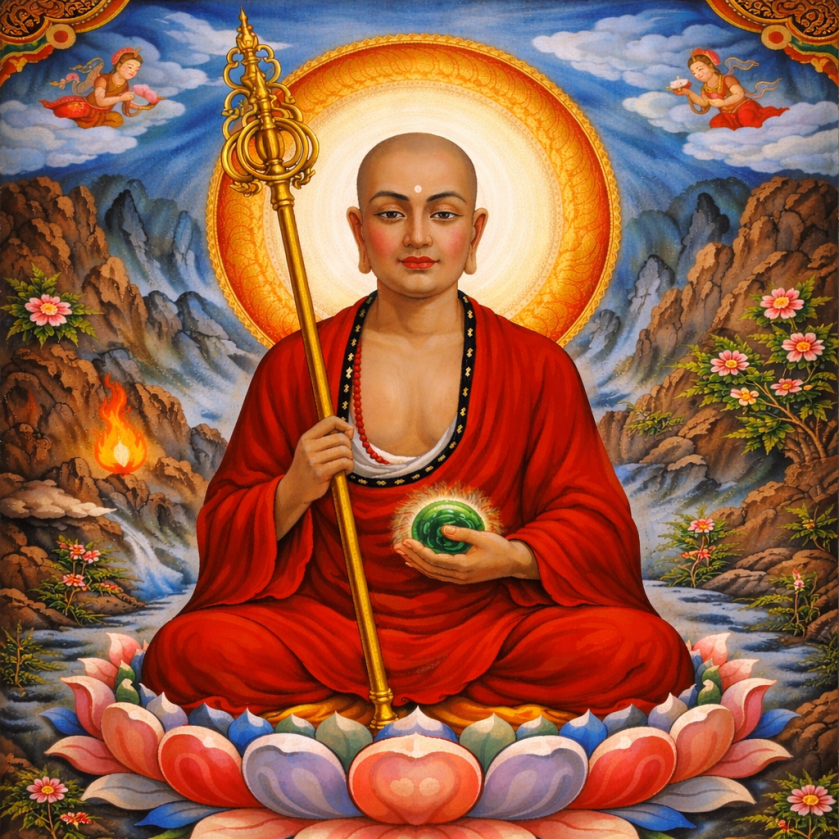
The Buddha then explained that even with the vision of a Buddha the number could not easily be described. All of these beings were those whom Kṣitigarbha Bodhisattva had guided and transformed throughout countless ages, and many more would be guided by him in the future.
Manjuśrī Requests the Story of Kṣitigarbha
Manjuśrī then said that although he personally believed the Buddha’s words, many beings in future ages might doubt them.
Followers of different paths, heavenly beings, dragons, spirits, and beings yet to be born might hesitate to accept the extraordinary powers attributed to Kṣitigarbha Bodhisattva.
Therefore he respectfully requested that the Buddha explain the original vows and deeds of Kṣitigarbha Bodhisattva, so that beings in future generations could understand the source of his immense spiritual authority.
The Vastness of Kṣitigarbha’s Practice
The Buddha replied that the deeds performed by Kṣitigarbha Bodhisattva over countless kalpas were beyond ordinary description.
To illustrate this, the Buddha used an immense comparison. Even if every blade of grass, every tree, every mountain, stone, grain of sand, and particle of dust were counted, and even if each grain of sand represented a world and each dust particle represented a kalpa, the number of Kṣitigarbha’s deeds would still surpass what could be expressed in words.
Even the achievements of those who had reached the stages of Arhatship or Pratyekabuddhahood could not compare with the vast practices performed by Kṣitigarbha Bodhisattva.
The Power of Kṣitigarbha’s Name
The Buddha further explained that the vows and spiritual powers of Kṣitigarbha Bodhisattva are truly inconceivable.
If future beings—whether men or women—hear his name, praise him, bow before him, make offerings to him, or create images of him through painting or sculpture, they will receive immense blessings.
Such beings will be reborn for one hundred lifetimes in the heavenly realm of Trāyastriṃśa, and they will never fall into the three evil destinies of suffering.
The First Vow of Kṣitigarbha
The Youth Before the Buddha Lion-Power
In a distant age beyond calculation, Kṣitigarbha Bodhisattva had once been the son of a respected elder.
At that time there was a Buddha named Lion-Power.
When the youth saw the majestic appearance of this Buddha, he wondered what practices and vows had produced such extraordinary qualities.
He asked the Buddha what one must do to obtain such a noble appearance.
The Buddha replied that if he wished to attain such perfection he must dedicate himself to relieving the suffering of all beings and continue this practice for an immeasurable span of time.
Inspired by this teaching, the youth made a powerful vow:
“I will devote myself to relieving the suffering of beings in the six realms of existence. Only after all beings are liberated will I myself attain Buddhahood.”
Because of this vow he has remained in the Bodhisattva stage for countless kalpas.
The Story of the Brahman Girl
A Daughter of Great Virtue
In another distant age there lived a Buddha known as the Buddha of Flower of Meditation and Enlightenment.
At that time there was a Brahman girl who practiced great generosity and compassion. Because of her kindness she was widely respected, and heavenly beings often protected her.
However, her mother rejected the Buddhist teachings and frequently spoke disrespectfully of the Triple Gem—the Buddha, the Dharma, and the Sangha.
Although the girl repeatedly tried to guide her mother toward the right understanding, her mother remained stubborn and refused to listen.
The Mother Falls into Hell
When the mother eventually died, the daughter realized that because of her mother’s harmful actions and rejection of the Dharma, she had likely been reborn in the Avīci Hell, the deepest of the hell realms where suffering continues without interruption.
Filled with grief, the daughter sold all her possessions and used the wealth to make offerings at the temple of the Buddha of Flower of Meditation and Enlightenment.
Seeing the magnificent image of the Buddha of Flower of Meditation and Enlightenment, she bowed deeply and prayed to know where her mother had been reborn.
The Voice of the Buddha
As she knelt before the image in sorrow, a voice suddenly spoke from the sky:
“Sacred Girl, do not grieve so bitterly. I will tell you where your mother has gone.”
The girl asked who was speaking.
The voice replied:
“I am the Buddha of Flower of Meditation and Enlightenment, to whom you have just made your offerings. Because of your sincere devotion and filial love, I have come to reveal your mother’s fate.”
The Vision of the Sea of Suffering
Following the Buddha’s instructions, the girl returned home and meditated deeply on his name.
After meditating for a full day and night, she suddenly found herself standing upon the shore of a vast and terrifying sea.
Within the boiling waters countless suffering beings struggled desperately to escape. Fierce iron-skinned monsters attacked them while terrifying demons drove them toward their punishment.
The scene was horrifying, yet through the power of the Buddha she felt no fear.
The King of the Devils
At that moment a powerful being named King No-Poison approached her.
He greeted her respectfully and asked why she had come to such a place.
He explained that the sea before her was part of the realm of suffering where beings who committed evil deeds during their lives must endure punishment after death.
These beings had lived sinful lives and had no descendants performing good deeds on their behalf during the forty-nine days after death.
Because of this they were forced to cross the Sea of Suffering before entering the various hells.
The Realms of Hell
King No-Poison explained that beyond the seas of suffering lay countless hell realms.
There were eighteen great hells and hundreds of smaller ones where beings endured punishments according to the severity of their actions.
Those who committed lesser offenses experienced milder punishments, while those guilty of grave wrongdoing endured intense suffering.
The Fate of the Girl’s Mother
When the girl told King No-Poison the name of her mother, he explained that her mother had already been saved.
Because of the girl’s sincere devotion and the offerings she had made to the Buddha of Flower of Meditation and Enlightenment, her mother had been released from hell three days earlier and reborn in heaven.
Not only had her mother been liberated, but all the sinners suffering in the Avīci Hell had also gained relief at that same time.
The Great Vow of the Brahman Girl
Overwhelmed with relief and gratitude, the girl knelt before the Buddha and made a powerful vow:
“In all my future lives throughout countless kalpas, I will dedicate myself to relieving the suffering of all beings.”
The Buddha then revealed to Manjuśrī that the King No-Poison later became the Bodhisattva of Wealth, and the Brahman girl who made this vow is the Bodhisattva Kṣitigarbha.

