

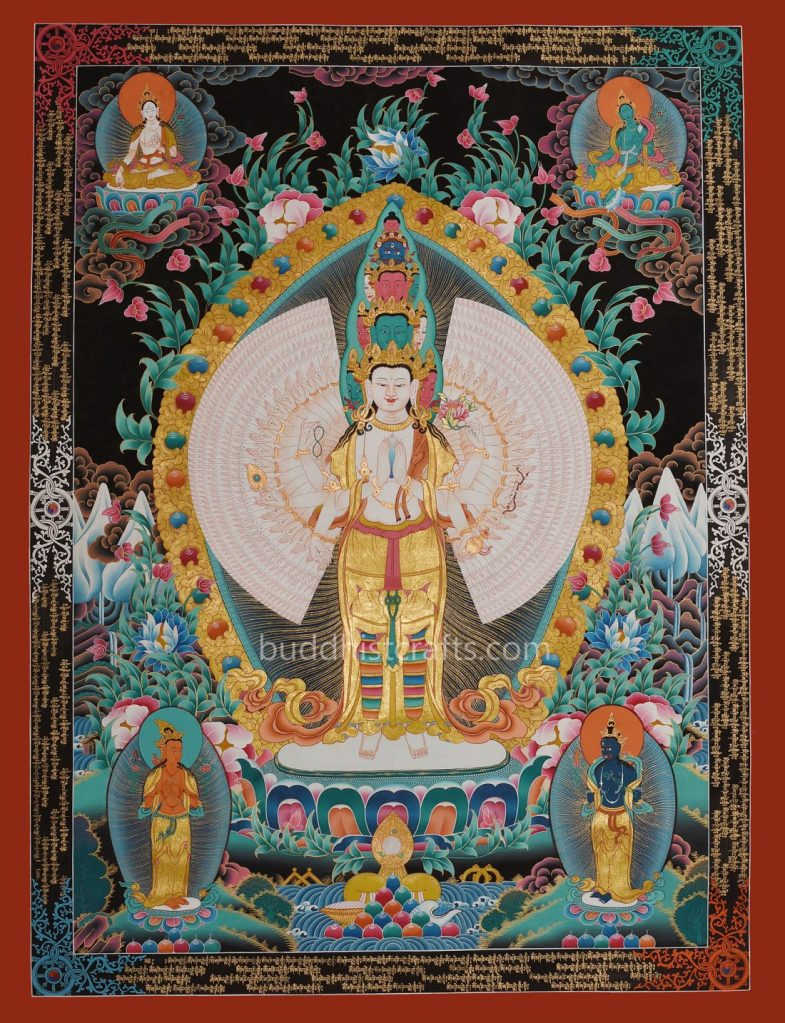
The Question of Akshayamati
In the Universal Gate Chapter of the Lotus Sutra, the bodhisattva Akshayamati rises respectfully from his seat before the Buddha. As a sign of reverence, he uncovers his right shoulder, joins his palms together, and bows before the World-Honored One.
He then asks the Buddha a question:
“World-Honored One, for what reason is the Bodhisattva Avalokiteshvara known by this name?”
The Meaning of the Name Avalokiteshvara
The Buddha replies that Avalokiteshvara is given this name because he hears the cries of living beings. If countless beings who suffer from many forms of hardship and distress hear the name of Avalokiteshvara and sincerely recite it with focused devotion, the bodhisattva will immediately hear their voices and respond to them.
Because he listens to the cries of the world and responds with compassion, he is known as Avalokiteshvara.
Protection from Fire, Flood, and Danger
The Buddha then explains the many ways in which Avalokiteshvara protects those who remember him.
If someone who calls upon Avalokiteshvara finds themselves surrounded by a great fire, the flames will not harm them because of the bodhisattva’s spiritual power.
If a person is caught in a violent flood and calls upon Avalokiteshvara, they will find safe ground.
If travelers sail across the vast ocean and their ship is threatened by powerful winds and storms, even if only one person among them calls upon the name of Avalokiteshvara, all those aboard will be saved from danger.
For this reason, the bodhisattva is known as Avalokiteshvara—the one who hears the cries of suffering beings.
Protection from Enemies and Evil Spirits
The Buddha continues by describing other dangers from which Avalokiteshvara protects those who invoke him.
If a person who is being attacked by enemies calls upon Avalokiteshvara, not even a single hair on their body will be harmed.
If demons or malevolent spirits attempt to torment someone who invokes Avalokiteshvara’s name, those beings will lose their power and will not even be able to look upon that person with hostile intent.
If someone is imprisoned or bound in chains and sincerely calls upon the bodhisattva’s name, they will be freed.
Protection for Travelers and Merchants
The Buddha then describes a group of merchants traveling along a dangerous road known to be infested with bandits.
Among them, one person says to the others:
“Good men, do not be afraid. If we all recite the name of Avalokiteshvara Bodhisattva with sincerity, we will be protected. This bodhisattva grants fearlessness to all beings.”
If the merchants together call out the name of Avalokiteshvara, they will immediately be saved from the bandits and escape the danger.
Because Avalokiteshvara grants fearlessness to living beings, his compassionate power is said to be vast and immeasurable.
Transformation of Desire, Anger, and Delusion
The Buddha further explains that devotion to Avalokiteshvara not only protects people from external dangers but also transforms the mind.
If those who are filled with strong desires sincerely recite the bodhisattva’s name, their attachment will gradually diminish.
If those consumed by anger and hatred remember Avalokiteshvara, they will become free from hatred.
If those who are confused or deluded call upon the bodhisattva, they will gradually overcome ignorance and foolishness.
Because Avalokiteshvara brings such benefits to living beings, the Buddha says that people should always keep the bodhisattva in their thoughts.
Blessings and the Birth of Virtuous Children
The Buddha also explains that those who worship Avalokiteshvara with sincerity may receive many blessings.
For example, if parents wish for children and make offerings to the bodhisattva, they may be blessed with virtuous and wise children who possess good qualities cultivated in past lives. Such children will be respected and admired by others.
Because Avalokiteshvara has such powers, anyone who bows to him with devotion will receive blessings, and their efforts will not be in vain.
The Merit of Reciting Avalokiteshvara’s Name
The Buddha then asks Akshayamati a question.
Suppose someone were to honor and make offerings to countless bodhisattvas throughout their entire life, providing them with food, clothing, bedding, and medicine. Would the merit from such actions be great?
Akshayamati replies that such merit would indeed be very great.
But the Buddha explains that if another person were simply to uphold the name of Avalokiteshvara and bow to him even once with sincere devotion, the merit and blessings gained would be equal to that of the first person.
Such merit could not be exhausted even over hundreds of thousands of countless ages.
Thus the Buddha declares that the blessings gained from remembering Avalokiteshvara are immeasurable and limitless.
Avalokiteshvara’s Many Manifestations
Akshayamati then asks the Buddha how Avalokiteshvara appears in the world in order to save living beings.
The Buddha explains that Avalokiteshvara manifests in whatever form is necessary to guide beings toward the Dharma.
If someone can be saved by seeing a Buddha, Avalokiteshvara will appear as a Buddha.
If they must be guided by a Pratyekabuddha, he will appear in that form.
If they can be helped by a disciple of the Buddha, he will appear as a disciple.
He may also appear as a god, a king, a heavenly general, a minister, an elder, a monk, a nun, or an ordinary layperson.
Avalokiteshvara may also appear as dragons, spirits, celestial beings, or even powerful guardian figures wielding the vajra.
In this way, the bodhisattva travels through countless worlds, appearing in whatever form is needed to guide and liberate living beings.
The Offering of the Pearl Necklace
After hearing this teaching, Akshayamati offers Avalokiteshvara a magnificent necklace made of precious pearls, worth an immense fortune.
However, Avalokiteshvara initially refuses to accept the offering.
Akshayamati respectfully asks him again to accept the necklace out of compassion.
The Buddha then tells Avalokiteshvara that he should accept the gift out of kindness toward the assembled beings present there—monks, nuns, lay followers, gods, dragons, spirits, and many others.
Out of compassion for them, Avalokiteshvara finally accepts the necklace.
He then divides it into two equal parts. One part he offers to Shakyamuni Buddha, and the other he offers to the stupa of the Buddha known as Many Jewels.
Through this act, Avalokiteshvara demonstrates his spiritual freedom and compassion as he continues to travel throughout the worlds relieving suffering.
Ksitigarbha’s Declaration of Merit
At that moment, the bodhisattva Ksitigarbha, known as the Guardian of the Earth, rises from his seat and addresses the Buddha.
He declares that anyone who hears this chapter describing the compassionate deeds, spiritual powers, and manifestations of Avalokiteshvara should understand that the merit gained from hearing and upholding these teachings is immeasurable.
Those who listen to and understand the Universal Gate Chapter will gain vast merit and virtue.
 buddhismunfiltered.com